info@fstindia.in
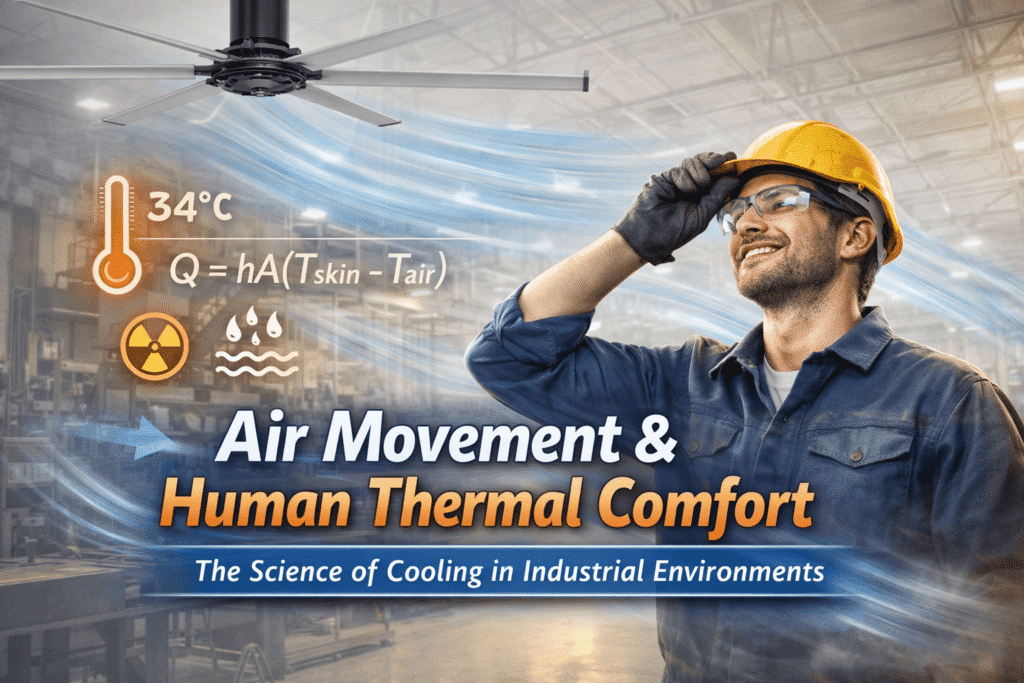
On many industrial shop floors, workers often notice something interesting— when air starts moving across the workspace, the environment instantly feels cooler, even though the temperature hasn’t changed.
This is commonly observed in factories using air circulators or HVLS fans. The thermometer may still read 34°C, but workers feel significantly more comfortable.
This is not psychological.
It is a result of heat transfer physics and human thermoregulation.
Understanding this is essential for designing efficient industrial cooling systems.
The Human Body as a Heat Engine
The human body continuously generates heat through metabolism.
During moderate industrial work, a worker produces approximately:
- 100–300 watts of metabolic heat
To maintain a stable body temperature (~37°C), this heat must be released into the environment.
The body dissipates heat through:
- Conduction – heat transfer to surfaces
- Radiation – heat emission to surroundings
- Convection – heat transfer to air
- Evaporation – cooling via sweat
Among these, convection and evaporation are strongly influenced by air velocity.
The Role of Convective Heat Transfer
Convective heat transfer occurs when moving air carries heat away from the skin.
Q=hA(Tskin−Tair)
Where:
- Q = heat transfer rate
- h = convective heat transfer coefficient
- A = skin surface area
- Tskin = skin temperature
- Tair = air temperature
Key Insight:
The value of h increases with air velocity.
When air moves faster:
- The warm air layer around the body is removed
- Heat transfer increases
- The body cools more efficiently
Even without lowering the temperature, airflow makes the environment feel cooler.
The Boundary Layer Effect
When air is still, a thin warm air layer forms around the skin.
This is called the thermal boundary layer.
In stagnant air:
- Heat transfer slows down
- Cooling becomes inefficient
In moving air:
- The boundary layer breaks
- Fresh air replaces warm air
- Heat loss increases
This is why airflow dramatically improves comfort.
The Impact on Sweat Evaporation
Evaporation is one of the most powerful cooling mechanisms.
When sweat evaporates, it removes heat from the body.
In stagnant air:
- Moisture builds up
- Evaporation slows
In moving air:
- Moisture is removed continuously
- Evaporation increases
Result: More effective cooling
Perceived Temperature vs Actual Temperature
Because convection and evaporation improve with airflow, the human body experiences greater heat loss.
This creates the sensation of a lower temperature.
The concept of perceived temperature or effective temperature accounts for this phenomenon.
For example:
Air Temperature | Air Velocity | Perceived Temperature |
34°C | 0.1 m/s | Feels like 34°C |
34°C | 1.0 m/s | Feels like ~30–31°C |
34°C | 2.0 m/s | Feels like ~28–29°C |
Thus, increasing air velocity can produce a perceived cooling effect of 3–6°C without actually lowering the air temperature.
This principle is widely used in industrial ventilation and air circulation design.
Air Velocity and Industrial Thermal Comfort
Large factories often struggle with heat because of:
- high roof structures
- large volumes of air
- process heat from machinery
- solar heat gain from roofs
Cooling the entire air volume of such buildings is energy intensive. However, improving air velocity at the worker level can significantly enhance comfort without reducing ambient temperature.
This is why air circulation systems such as:
- HVLS fans
- industrial air circulators
- strategic airflow systems
are widely used in manufacturing environments.
These systems increase air movement across workers, improving convective and evaporative heat loss.
Optimal Air Velocity for Industrial Workspaces
Engineering guidelines suggest that air velocities in the range of:
0.5 – 2.5 m/s
can significantly improve thermal comfort in warm environments.
However, airflow must be carefully designed.
Excessive air velocity may cause:
- dust movement
- disruption of lightweight materials
- discomfort in precision work areas
Therefore, airflow systems must be engineered to provide uniform air distribution without turbulence.
Air Velocity as an Energy-Efficient Cooling Strategy
Increasing air velocity is one of the most energy-efficient ways to improve perceived temperature.
Instead of lowering air temperature across the entire building volume, airflow improves human heat dissipation directly.
This approach offers several advantages:
- lower energy consumption
- faster response to heat conditions
- improved comfort across large spaces
For this reason, air circulation is often considered the first line of thermal comfort engineering in large factories.
Engineering Perspective
Temperature alone does not determine thermal comfort. Comfort depends on the interaction of several environmental parameters:
- air temperature
- air velocity
- humidity
- radiant heat
- metabolic activity
Among these, air velocity is one of the most powerful variables influencing perceived temperature. Properly engineered airflow can dramatically improve working conditions even when ambient temperatures remain high.
Final Insight
On the shop floor, cooling the air is not always necessary to make people feel cooler.
Sometimes, moving the air intelligently is enough.
By increasing air velocity, the body can dissipate heat more effectively, improving comfort, reducing fatigue, and supporting sustained productivity.
Understanding and engineering this interaction between air movement and human physiology is essential for designing high-performance industrial workplaces.
At Five Star Technologies, we design airflow systems that don’t just move air— they create productive & efficient shop floors.
If your facility is struggling with heat, the solution may not be more cooling— it may be better airflow engineering.