info@fstindia.in
1. Introduction
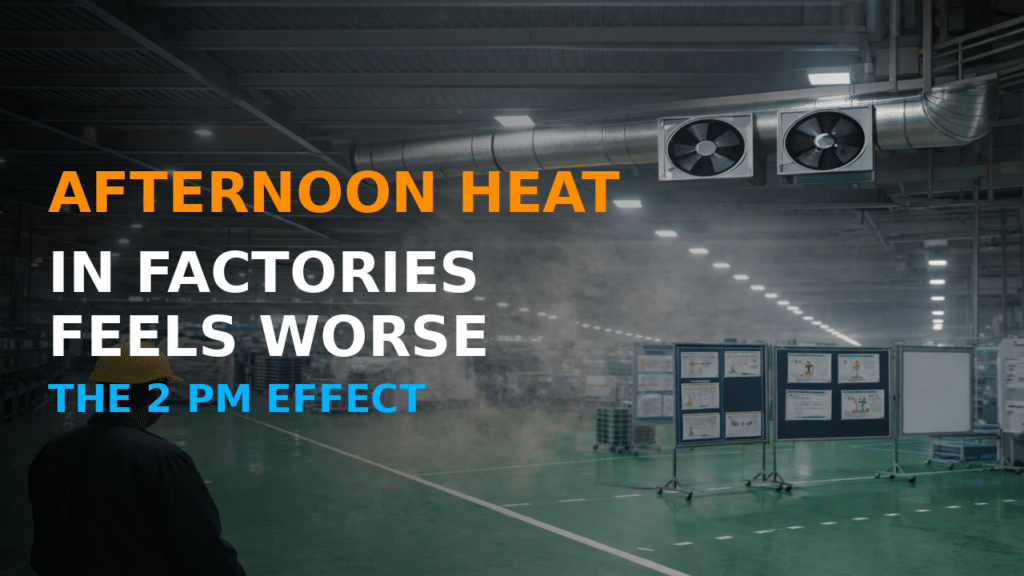
Afternoon heat discomfort on shop floors is one of the most frequently reported operational issues.
- Workers feel significantly more fatigued post-lunch
- Perceived temperature rises disproportionately
- Output consistency drops in later hours of the shift
What makes this problem technically interesting is that:
In many cases, the measured temperature increase from morning to afternoon is marginal, yet discomfort increases sharply.
This indicates that the issue is not purely temperature-driven.
It is a result of thermal accumulation and system imbalance over time.
2. Temperature vs Perceived Heat
Thermal comfort is not determined by air temperature alone.
Human perception of heat is influenced by:
- Air temperature
- Radiant temperature (heat from surfaces like roofs and machines)
- Air velocity
- Humidity
- Duration of exposure
In the morning:
- Lower radiant heat
- Lower accumulated load
- Better physiological tolerance
By afternoon:
- Radiant heat increases
- Air stagnation increases
- Body fatigue reduces heat tolerance
Even a 2–3°C increase in temperature, combined with higher radiant heat and lower air movement, can feel like a 5–8°C increase in perceived heat.
This is why workers often report:
“Same temperature, but much more discomfort.”
3. Thermal Accumulation
Afternoon heat is primarily a time-dependent phenomenon driven by accumulation.
Continuous Heat Gain
Throughout the day, heat is continuously added to the system from:
- Solar radiation
- Machines and processes
- Lighting systems
This heat is not instantaneous—it builds progressively.
Delayed Heat Release
Industrial buildings, especially with metal roofs and large volumes, have:
- High heat absorption
- Slow heat dissipation
The structure itself (roof, walls, air mass) acts as a thermal storage system.
By afternoon:
- The building starts re-radiating stored heat back into the workspace
System Imbalance
The critical issue is imbalance:
Heat entering + Heat generated > Heat removed
When removal mechanisms (ventilation, airflow) do not match heat load:
- Internal temperature drifts upward
- Radiant heat increases
- Stratification intensifies
This imbalance peaks in the afternoon.
4. Heat Sources
Solar Radiation (Roof)
The roof is the largest single contributor to heat gain.
- Metal roofs can reach 60–70°C surface temperatures
- Heat transfers via conduction and radiation
- Radiant heat load increases progressively through the day
By afternoon, the roof behaves like a continuous heat emitter.
Internal Loads (Machines & Lighting)
Industrial operations add constant internal heat:
- Injection moulding, furnaces, compressors
- Motors and drives
- Lighting systems
This heat is cumulative and non-stop during production hours.
By mid-afternoon:
- Internal heat load reaches peak levels
- Combined with roof heat, it creates a compounded effect
5. Ventilation Limitation
Ventilation is expected to remove heat—but often fails due to design limitations.
Exhaust Not Matching Load
Most systems are:
- Constant speed
- Fixed capacity
But heat load is dynamic and time-dependent.
By afternoon:
- Heat generation exceeds exhaust capacity
- Air exchange becomes insufficient
Heat Trapping
Without effective high-level exhaust:
- Hot air accumulates near the roof
- Stratification increases
- Heat slowly radiates downward
Additionally:
- Poor airflow distribution prevents effective mixing
- Fresh air may not reach occupied zones
Result:
Heat is not removed—it is redistributed.
6. Engineering Solutions
Afternoon heat cannot be solved by static systems.
It requires dynamic, time-based engineering control.
1. Time-Based Ventilation Strategy
Ventilation must be aligned with heat load progression.
- Increase exhaust capacity during peak solar hours (12 PM – 4 PM)
- Use staged or variable-speed ventilation
- Pre-emptively remove heat before accumulation peaks
This prevents thermal buildup instead of reacting to it.
2. Heat Release Optimization
Focus on removing heat at its source:
- Ridge ventilators or high-level exhaust for roof heat
- Localized extraction near high-heat machines
- Vertical heat evacuation paths
This reduces thermal layering and prevents downward radiation.
3. Load Reduction
Reduce the amount of heat entering the system:
- Roof insulation or reflective coatings
- High-efficiency lighting with lower heat output
- Process heat containment strategies
Lower input = lower accumulation.
4. Airflow Engineering
Improve air movement at worker level:
- HVLS fans or air circulators
- Uniform air distribution across zones
- Breaking stratification layers
This enhances convective and evaporative cooling, improving perceived comfort.
5. Integrated Control Approach
The most effective solution is not a single intervention.
It is integration of:
- Heat entry control
- Heat removal systems
- Air movement
- Time-based operation logic
This converts a passive system into an actively managed thermal environment.
7. Conclusion
Afternoon heat discomfort is not a simple temperature issue.
It is the result of:
- Continuous heat accumulation
- Delayed heat release from building structures
- Mismatch between heat generation and removal
In technical terms:
Afternoon discomfort is a system failure, not a temperature problem.
Factories that treat it as a cooling issue will continue to struggle.
Factories that engineer heat as a dynamic system—with visibility, timing, and integration—achieve:
- Stable thermal conditions
- Reduced worker fatigue
- Consistent productivity across shifts
- Lower energy consumption
The solution lies not in fighting the heat harder,
but in managing how it builds, moves, and exits the system.
Is your factory getting hotter every afternoon?
This is not a cooling issue—it’s a system design problem.
At Five Star Technologies, we engineer complete heat management systems that control heat at its source
Contact us today and transform your shop floor into a stable, productive environment.